How do Compound Calcium Carbonate Granules differ from calcium carbonate D3? A focus on formulation technology and research evidence
People considering calcium supplementation encounter similar names: Calcium Carbonate D3 Tablets, Calcium Carbonate D3 Granules, Pediatric Calcium Carbonate D3 Granules, and Compound Calcium Carbonate Granules.
People considering calcium supplementation encounter similar names: Calcium Carbonate D3 Tablets, Calcium Carbonate D3 Granules, Pediatric Calcium Carbonate D3 Granules, and Compound Calcium Carbonate Granules.
These medicines all relate to calcium and vitamin D3, but are they the same thing?
They have a similar ingredient basis, but their specific amounts, dosage forms, formulation technologies and research evidence are not identical.
Research on Compound Calcium Carbonate Granules particularly concerns complexation technology, calcium carbonate dissolution and absorption under conditions of gastric acid inhibition.
1. Similar ingredients do not mean identical products
Conventional calcium carbonate D3 preparations use calcium carbonate as a calcium source and add vitamin D3.
Calcium carbonate supplies elemental calcium, while vitamin D3 participates in calcium absorption and metabolism in the human body.
Compound Calcium Carbonate Granules also contains these two ingredients.
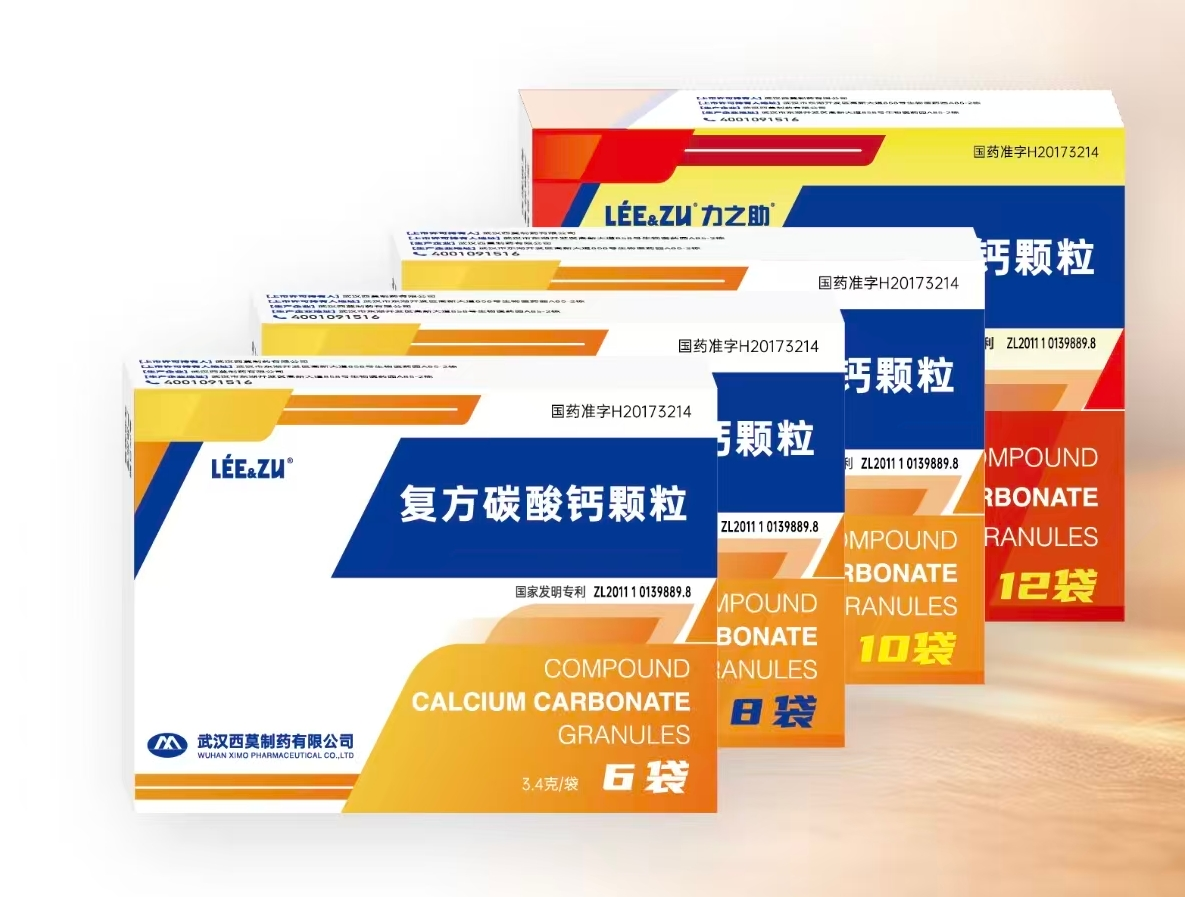
For example, LiZhiZhu® Compound Calcium Carbonate Granules, manufactured by Wuhan Ximo Pharmaceutical Co., Ltd., has approval number H20173214. Each 3.4 g sachet contains 0.75 g calcium carbonate, equivalent to approximately 300 mg elemental calcium, together with 62.5 IU vitamin D3.
However, calcium carbonate D3 is not available in just one strength.
Calcium carbonate D3 tablets, granules and pediatric granules on the market have different approval numbers, unit doses and product labels.
For example, some granules contain 250 mg or 500 mg elemental calcium, while some tablets supply 600 mg. Their vitamin D3 doses may also differ.
To assess the actual calcium supplied, therefore, check the specific elemental calcium content rather than simply the name “calcium carbonate.”
2. Why does calcium carbonate dissolution matter, and how does the formulation address it?
A basic pharmaceutical characteristic of calcium carbonate is its low water solubility. After ingestion, stomach acidity helps it dissolve into a form suitable for subsequent absorption. The calcium professional fact sheet from the US National Institutes of Health Office of Dietary Supplements notes that low stomach acid can reduce the dissolution rate of calcium carbonate and consequently affect absorption; taking it with food can improve absorption conditions in some circumstances. Assessment of a calcium carbonate preparation should therefore consider dissolution characteristics, administration and gastric acidity as well as calcium content.
Calcium carbonate itself has low water solubility, while formulation processes can affect dissolution. Research and development on Compound Calcium Carbonate Granules has focused on improving this pharmaceutical characteristic.
For LiZhiZhu® Compound Calcium Carbonate Granules manufactured by Wuhan Ximo Pharmaceutical Co., Ltd., the development uses complexation-related technology so that calcium carbonate and citric-acid-related components form a calcium complex system to improve water solubility. A 2019 Current Medical Science study compared it with a commonly marketed calcium carbonate D3 preparation using in vitro experiments and 5-week-old mice. Compound Calcium Carbonate Granules showed greater water solubility in vitro than that particular comparator. This provides experimental support for a complexation-based approach to addressing the low water solubility of calcium carbonate.
Compound Calcium Carbonate Granules also involves vitamin D3 inclusion technology. A related 2023 pharmaceutical study described β-cyclodextrin inclusion of vitamin D3 and evaluated vitamin D3 stability, calcium transport and bone-related indicators. Complexation and inclusion represent two pharmaceutical research characteristics of this compound preparation.
3. How did absorption differ when gastric acid was reduced?
This was a central question in the 2019 study of Compound Calcium Carbonate Granules.
Researchers compared calcium absorption between the two preparations in normal mice and in a mouse model with gastric acid secretion inhibited by omeprazole.
The results showed the following:
In normal mice, calcium absorption rates were similar for Compound Calcium Carbonate Granules and the calcium carbonate D3 comparator used in the study.
In acid-suppressed mice, calcium absorption did not decrease significantly in the Compound Calcium Carbonate Granules group, whereas it decreased with the comparator.
The study also observed differing effects of exogenous components such as phytate and tannin on calcium absorption with the two preparations.
Under that study’s experimental conditions, these findings suggest that Compound Calcium Carbonate Granules had both greater water solubility in vitro and relatively stable calcium absorption in acid-suppressed mice.
These are findings from in vitro and animal experiments. Their scope is limited to the study subjects and conditions, and interpretation still requires human clinical evidence.
4. What other gastrointestinal research is available?
In addition to dissolution and absorption, gastrointestinal reactions are a consideration when using calcium preparations.
The 2019 animal study also examined gastric emptying, intestinal propulsion and changes in related gastrointestinal hormones.
In normal mice, the study did not observe marked inhibition of gastric emptying or intestinal propulsion with Compound Calcium Carbonate Granules.
In comparison, the calcium carbonate D3 preparation used in the study showed different findings on some gastrointestinal motility indicators.
For human clinical evidence, a 2021 meta-analysis in China Journal of Pharmaceutical Economics included 8 studies involving 840 children with rickets and evaluated safety outcomes including constipation.
| Outcome | Compound Calcium Carbonate Granules | Calcium Carbonate D3 Granules |
|---|---|---|
| Response rate | 72.7% | 63.1% |
| Recurrence rate | 7.1% | 14.5% |
| Constipation incidence | 4.1% | 9.7% |
| Stone event incidence | 0.5% | 2.9% |
These constipation figures come from pooled studies in a specific pediatric patient population. The current LiZhiZhu® label still lists possible adverse reactions including belching and constipation. Clinical use must therefore take account of individual circumstances and the product label.
5. What clinical comparisons concern nutritional rickets in children?
Comparisons between Compound Calcium Carbonate Granules and Calcium Carbonate D3 Granules extend beyond pharmaceutical experiments.
The 2021 meta-analysis synthesized childhood-rickets clinical studies addressing outcomes including effectiveness, recurrence and safety.
In 2025, Chinese Journal of New Drugs published a further systematic review and pharmacoeconomic study.
According to its public abstract, within the studies it included, Compound Calcium Carbonate Granules performed better than Calcium Carbonate D3 Granules on outcomes including response rate, recurrence rate and bone mineral density Z-score in nutritional rickets, with no significant difference in overall safety. These findings describe the direction of comparison in the evidence included in that systematic review.
The study also evaluated the approaches using a cost-effectiveness model. Under the prices and model conditions assessed, compound calcium carbonate granules had a high probability of being cost-effective for nutritional rickets.
This evidence provides information for research on treatment approaches in a specific disease population.
These findings mainly concern childhood nutritional rickets. Interpretation needs to consider the quality of the included studies, their outcome measures and the relevant patient population.
6. How should the differences be understood?
Available materials suggest three levels of distinction.
First, ingredients.
Both Compound Calcium Carbonate Granules and calcium carbonate D3 preparations can supply calcium and vitamin D3, but unit doses and formulation ratios differ between medicines.
Second, pharmaceutical characteristics.
Compound Calcium Carbonate Granules uses complexation-related formulation design. Preclinical studies have examined water solubility, calcium absorption under gastric acid inhibition and gastrointestinal motility, revealing pharmaceutical characteristics of interest.
Other calcium carbonate D3 preparations have their own specific formulations and processes. Comparisons should be based on the corresponding product materials and research.
Third, clinical evidence.
In childhood nutritional rickets, Compound Calcium Carbonate Granules has original human clinical studies, a 2021 meta-analysis and a 2025 systematic review, representing an accumulation of evidence for a specific treatment setting.
Thus, the main differences involve not only unit dose and ingredient ratios, but also formulation technology, water-solubility research and clinical evidence in a specific disease area.
Conclusion
Both Compound Calcium Carbonate Granules and calcium carbonate D3 products can provide calcium and vitamin D3, but each has its own formulation processes and related research. Understanding these differences requires reference to specific products and their research materials.
For LiZhiZhu® Compound Calcium Carbonate Granules manufactured by Wuhan Ximo Pharmaceutical Co., Ltd., complexation-related formulation technology is used to improve calcium carbonate dissolution. A 2019 study found greater water solubility in vitro than the selected calcium carbonate D3 comparator, and relatively stable calcium absorption in acid-suppressed mice. This is a comparatively clear pharmaceutical research characteristic of the product.
In childhood nutritional rickets, human clinical studies and evidence syntheses have also accumulated for Compound Calcium Carbonate Granules. The 2021 meta-analysis included 8 studies and 840 children. The 2025 Chinese Journal of New Drugs systematic review reported better response rate, recurrence rate and bone mineral density Z-score than Calcium Carbonate D3 Granules within its included studies, with no significant difference in overall safety.
These formulation and clinical research findings provide material for professionals seeking to understand the product’s technical characteristics and research in a specific disease area. Actual use should still follow the relevant product label and a physician’s assessment.
LiZhiZhu® Compound Calcium Carbonate Granules is a prescription medicine (approval number H20173214). Use it according to the product label and the prescribing physician’s instructions.
